

Glossary of CryptoCurrency Terminology
The BitCoin and CryptoCurrency worlds use a lot of their own unique slang and terminology that can be intimidating to beginners and those looking to start investing. While this lingo may make it easier for people who are already knowledgeable and experienced in cryptocurrencies and investments to communicate, it can make it difficult for those who are new to read news articles and social media posts and properly understand everything.
So I have compiled this list of definitions to many of the common words, phrases, initials, and acronyms related to BitCoin and CryptoCurrencies.
The Basics
Moon / Mooning
Example: “Ethereum is Mooning!”
When a coin is “mooning” its price is experiencing a sudden spike upwards in a short amount of time. It has become one of the most common words associated with BitCoins and CryptoCurrencies.
Another way to definite moon is: Extreme bullish movement of a coin.
To The Moon
Example: “TRON is going To The Moon right now!”
An expression for when a coin is having a sharp increase in value.
Can also be used as an exclamation, such as “Hold on Everyone, We’re Going To The Moon!”.
Lambo
Example: “You order your Lambo yet?”
Short for Lamborghini.
Used as an exclamation of making a lot of money from cryptocurrencies, usually after a coin moons.
Fiat
Example: “I made one hundred dollars today!”
A fiat currency is any physical paper/metal currency by almost every country on the planet.
Fiat Currencies are generally issued by Governments and central banks, and are centralized and highly regulated.
BitCoin (₿)
Example: “I bought one BitCoin today!”
The first decentralized digital currency worldwide payment system, which works without a central bank or single administrative body.
Bitcoins are created as a reward for a process known as mining.
The network is peer-to-peer and transactions take place between users directly, without an intermediaries. These transactions are verified by network nodes through the use of cryptography and recorded in a public distributed ledger called a blockchain.
Bitcoin was invented by an unknown person or group of people under the name Satoshi Nakamoto and released as open-source software in 2009.
AltCoin
Example: “I mined one Monero today!”
Any digital cryptocurrency other than Bitcoin.
As Bitcoin is the most popular cryptocurrency, there are more than 1,000 other coins which are all referred to as AltCoins.
ShitCoin
Example: “I Invested Everything I Had in BitConneeeeect!”
An altcoin which is generally considered worthless as it lacks a product or useful features in the development of its blockchain.
While shitcoins are typically considered worthless, they are known to occasionally moon.
Wallet
Example: “Hey Dude, Whats your BitCoin Wallet?”
The software used to store the private keys associated with a given cryptocurrency.
This digital or physical address is used to send, receive, and store cryptocurrencies in cold storage.
Address
Example: “Hey You, What’s your BitCoin Wallet?”
An string of code used to send, receive or store cryptocurrency.
BitCoin Addresses generally consist of 26-35 characters, and a combination of letters and numbers.
Ethereum and other addresses can consist of 256 characters or more.
The address can also refer to the public key, a pair of keys needed to sign their digital transactions.
Public Key
Example: “I’ll send you some Ripple once i get you public key.”
A public address is the cryptographic hash of a public key which is shared with other people to send & receive coins.
Private Key
Example: “Never Give Away Your Private Key.”
The encryption key associated with a cryptocurrency wallet.
Private keys are to be kept secret, and known only to the owner of the wallet.
PassPhrase
Example: “Write Down Your Wallets Passphrase on a Piece of Paper.”
Some cryptocurrency wallets use a standard for generating multiple accounts using only a single (pseudo or truly) random value.
Instead of using just ten words, we can store more digits at a time using a larger vocabulary.
Recovery passphrases allow for a relatively short sequence of words to be turned into a private key.
Cold Storage
Example: “I’m HODLing, so I put all of my Cardano into cold storage.”
A method of storing your cryptocurrencies in an offline manner to avoid hacking or theft.
The most common forms of offline storage is hardware wallets and paper wallets.
Exchange
Example: “I just bought a NEO on that new exchange!”
A website or service where you can buy or sell Cryptocurrencies using other cryptocurrencies.
Some exchanges allow you to purchase BitCoin and other cryptocurrencies using your Credit Cards, Debit Cards, Wire Payments, and other ways.
Popular exchanges include: Binance and CoinBase.
Faucet
Example: “WTF is a goddamn faucet?!”
Faucets are websites which give away a small amounts of bitcoins and other cryptocurrencies for free.
Each faucet site has a different system for giving away their crypto’s, but generally you can visit the site once every 5 – 60 minutes, complete a Captcha to prove your human, and then click a button to receive a small amount of cryptos.
AirDrop
Example: “Is this Airdrop legit or a scam?”
A method for a new cryptocurrency project or business to distribute their cryptocurrency to people free of charge.
This is usually done to bootstrap a project, or to reward users who are part of their community who’ve helped the project grow.
Slang
Satoshi Nakamoto
Example: “Satoshi Nakamoto is rumoured to have over a million BTC.”
The name of the unknown person (or group of people) who designed BitCoin and created the first blockchain database.
They were active in the development of BitCoin up until December 2010.
Satoshi’s
Example: “I only have 30,000 satoshi’s left”
Derived from the first name of bitcoin’s mysterious creator, Satoshi Nakamoto.
Refers to the smallest fraction of a bitcoin that can be sent, 0.00000001 of a bitcoin.
Sats
Example: “I’m down to only 500 sats.”
Short for “satoshis”, it refers to the smallest fraction of a bitcoin that can be sent, 0.00000001 of a bitcoin.
Instead of looking at bitcoin in terms of a dollar value, many investors view bitcoin in terms of sats.
Litoshi
Example: “I think I only have like 100 litoshi’s left.”
An amalgamation of satoshi and litecoin.
1 Litoshi represents the smallest fraction of a usable litecoin, 0.00000001 of a litecoin.
Minnows
Example: “The Whales are cutting back as the Minnows are Diving In”
Someone who has a small amount of cryptocurrency is thus considered to be a minnow, or “small fish”.
Dolphin
Example: “I bought so much of this shitcoin that I’m definitely a Dolphin.”
Someone who has graduated from the ranks of minnows and has some influence over the price movement of a cryptocurrency, but hasn’t yet reached the status of whale.
Whale
Example: “Get ready, here come the whales!”
Whales are huge players who make huge investments and control markets.
These are the people who own a ton of bitcoin, like hundreds of thousands of bitcoin or more.
When a whale sells a lot of their stake, it can cause the price of a cryptocurrency to dip as they flood the supply.
BagHolders
Example: “I use to be a hodler, now I’m just a BagHolder”
When a investor continues to hold on to a cryptocurrency after the price has significantly dropped.
Bags
Example: “I’ve got a lot of coins in a lot of bags”
Different holdings of altcoins in different “bags”.
Shill
Example: “First I was just excited about NEO, but I think I’ve just become a shill.”
The unsolicited endorsing of a cryptocurrency in public.
Many traders have an interest in shilling the coins they have bought to help raise public awareness and hopefully its price.
Weak Hands
Example: “Now that the weak hands are out, us true investors can continue forward.”
Traders who are impatient and sell at loss when the market dips.
Rekt
Example: “After BitConnect closed I was totally rekt.”
From the word “wrecked”.
When someone’s accounts are nearly zero due to the price of their coins collapsing.
Acronyms:
FOMO
Example: “I bought while it was mooning cause of FOMO.”
Fear of Missing out
FUD
Example: “The FUD is so thick you could cut it with a knife!”
Fear, Uncertainty and Doubt.
HODL
Example: “I’m not a day trader, I’m a hodler”
Hold On for Dear Life.
ATH
Example: “I was so lucky that I sold at its ATH!”
All Time High,
ICO
Example: “I made so much money because I was able to buy in on their ICO.”
Initial Coin Offering.
The initial sale of a new cryptocurrency to the public.
Based from IPO’s (Initial Price Offering) from the Stock Market and equities.
ROI
Example: “I expect an roi of at least 1 month.”
Return On Investment.
DApps
Example: “Apparently some guy sold a cat for over $40,000
on the DApp CryptoKitties.”
‘Decentralized application’ which run on an open source blockchain, such as Ethereum.
TA
Example: “Did you read over that ICO’s TA?”
Short for Technical Analysis.
Used by analysts to predict the price action and direction of a coin in the near future.
BTFD
Example: “WHY DID YOU YOU BTFD?!?!”
Buy The Fucking Dip.
DYOR
Example: “Dude! DYOR!”
Do Your Own Research.
DCA
Example: “Don’t worry about the dips, just make sure your DCA.”
Dollar Cost Averaging.
DAO
Example: “The cryptocurrency DASH is also a DAO.”
Decentralized Autonomous Organizations.
Also known as DAC, Decentralized Autonomous Corporations.
Organisations which run through rules encoded in as computer programs in smart contracts.
A DAO’s entire financial transaction records and program rules are maintained on a blockchain.
Inherited from the Financial Industry
Margin Trading
Example: “No Margin Trading means no risk of a Margin Call.”
A term for ‘trading with leverage’.
When someone borrows from one side of the trading pair at an agreed loan rate and sell it for the other side of the trading pair.
Depending on the direction you believe the market to move, you may place a long or a short bet on the trading pair of concern.
Limit Order
An order placed at a future price that will execute when the price target is hit.
Borrowing Rate
When someone opens a leveraged position by borrowing coins at a predetermined rate.
Lending Rate
Some exchanges have lending accounts, where you can deposit your coins and lend your coins for others to execute their leveraged trades.
The lending rate fluctuates throughout the day based on the demand for shorting a coin.
Fill or Kill
A limit order that will not execute unless an opposite order exceeds the limit order’s amount.
BUY | SELL Wall
A wall as seen in the depth chart of exchanges formed by the limit orders of the same price target.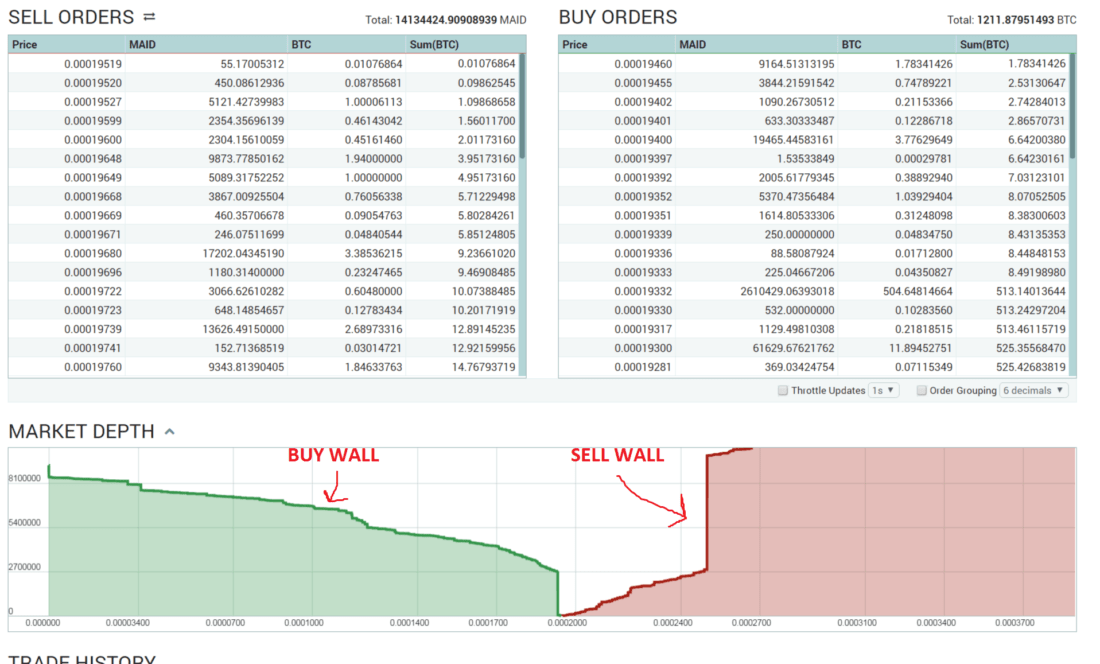
Arbitrage
Example: “I totally just arbitraged all these shitcoins to make a cool grand!”
Taking advantage of the price difference of the same coin between different exchanges to make a profit.
Pump and Dump
Example: “I lost over $200 when I tried to participate in a Pump and Dump group.”
When an investor or group of investors collectively buy into a coin to intentionally raise its price, only to sell it for a profit causing the price to suddenly fall back down.
Due to the unregulated nature of cryptocurrencies people are able to do things that would normally be illegal with stocks and other more regulated markets.
Bear / Bearish
Example: “Unfortunately LiteCoin was very bearish today.”
When a coin or market falls in value.
Bull / Bullish
Example: “Luckily Monero was Bullish today.”
When a coin or market raises in value.
Market Cap
Example: “Don’t listen to all that FUD, just look at its market cap!”
Refers to Market Capitalization.
A cryptocurrencies market cap refers to the market value of the currencies outstanding coins.
In the cryptocurrency market, the market cap is used to illustrate a coin’s position within the entire market.
Market Cap = ( Circulating Supply ) * ( Price)
Circulating Supply
Example: “The value of the individual coins is so low because there’s literally billions of coins circulating in supply.”
The total number of coins which are currently available to be bought and sold.
Circulating Supply = ( Market Cap ) ÷ ( Price )
Short / Shorting
Example: “I made a fortune shorting BitCoin back in February.”
When an investor takes a short position, they expect to profit from the price decreasing in the future.
Generally considered risky, as one could incur losses from a price increase.
Long
Example: “I bought 1 bitcoin in 2013 and sold it for over $15,000 of profit in 2017.”
Opposite of a shorting.
When an investor takes a long position, they expect to profit from the price increasing in the future.
Volatility
Example: “Cryptocurrencies have the most volatility compared to every other market.”
Volatility is a measure of a coin or market’s price movement over time.
A coin which rises and falls in value often is considered highly volatile, while a coin which rarely rises and falls in value is not considered to be very volatile.
The cryptocurrency markets are well known for their high levels of volatility.
Technical
WhitePaper
Example: “I never purchase a coin without reading its white paper first.”
The WhitePapers detail everything you need to know about a cryptocurrency for investors to read while they are considering investing in a currency.
This includes commercial, technological and financial details about a coin, written in a language that can be understood by someone who is not an expert in the space.
A new coins whitepaper is a pivotal component of their ICO, as it is the publics first introduction to the coin.
BlockChain
Example: “The first cryptographic blockchain was theorized in 1991 by Stuart Haber and W. Scott Stornetta.”
The underlying technology which makes BitCoin and all CryptoCurrencies possible, basically a list of every block ever mined.
They are distributed ledgers used to create and store transactions with Bitcoin and other cryptocurrencies.
These distributed ledgers are public databases which can be read by anyone, and are stored & run on up to thousands of servers and computers across the world.
Ledger
A public database that can be read by anyone, and are stored & ran on up to thousands of servers and computers across the world.
Agreement Ledger
A distributed ledger used by two or more parties to negotiate and reach a final agreement.
Attestation Ledger
A distributed ledger which provides for evidence or solid record of agreements, commitments and statements.
Node
The computers and servers which run the software necessary to store the public databases known as the blockchain.
ie, A copy of the ledger operated by a participant on the blockchain network.
Peer to Peer
Refers to the decentralized transaction between two or more parties without the need of middlemen.
Smart Contracts
Trustless peer-to-peer contracts to automatically validate certain terms and conditions.
Tokens
Generated by ICOs to exchange with the cryptocurrency in their ICO sales.
Fork / Forking
Example: “I got a bunch of new coins yesterday after an ethereum fork.”
Forks create an alternative version of the blockchain, running two versions simultaneously on different parts of the network.
Both forks retain all previous blocks, while all new blocks remain on their respective chain.
Forks can be both desirable and undesirable, as new forks can split a community and dilute market capitalization.
On the other hand, Forks are also able to create new wealth out of thin air.
Soft Fork
When a cryptocurrency has a soft fork only previously valid transactions are made invalid.
As old nodes only recognize the new blocks as valid, a soft fork is essentially backwards-compatible.
Soft forks requires miners to upgrade in order to enforce.
Hard Fork
Hard forks render all previously valid transactions invalid, and vice versa.
Hard forks require all nodes and users to upgrade to the latest version of the protocols software.
Scalability
A cryptocurrencies limits in terms of the amount of transactions the cryptocurrencies network can support.
This is related to the fact that blocks are limited in size and frequency.
Vote for Token Listing
Certain exchanges allow for voting of changes to their exchange and blockchain by using their own tokens, such as BnB with Binance and HT with Huobi.Pro.
51% Attack
When a single entity or group controls more than half of the computing power of a cryptocurrencies network and they issue conflicting transactions to harm the network. This essentially allows them to do literally anything with the network.
Solidity
A popular language that smart contracts can be written in.
SHA-256
A popular cryptographic algorithm used in the cryptocurrencies world.
Proof of Work
A consensus distribution algorithm which requires an active role in mining data blocks.
This typically means that the user with more computational more is rewarded more.
Proof of Stake
A consensus distribution algorithm which rewards earnings based on the number of coins you actively own or hold.
Typically this means the more you invest in the coin, the more you gain by mining it.
Gas
Example: “I had to pay .002 eth in gas just to transfer my ethereum to an exchange!”
The cost of paying miners to process your transaction on a blockchain.
Basically, it is measurement of how much processing is required by the ethereum network to process a transaction.
Crypto Mining
Crypto Mining
Example: “I have a friend who makes his entire living from mining BitCoin.”
Cryptocurrency mining is a way to validate blockchain transactions. The miners get coins as an incentive for validating transactions. It requires a good hardware to perform complex hashes.
Cryptocurrencies are mined, not in underground structures but with computer hardware. Mining involves using sophisticated computer hardware to solve complicated mathematical problems.
Mining Rig
Example: “I spent over ten grand on a new mining rig.”
Computers specifically designed for mining cryptocurrencies like Bitcoin and Ethereum.
These computers typically have powerful GPUs in an array to increase their computing power and consume a large amount of electricity.
Miners
Example: “No, not with a pickaxe. I’m a BitCoin miner.”
The people who operate the computers & servers which are used to solve the cryptographic problems attached to blockchain transactions.
Miners are rewarded for dedicating computing resources to the blockchain in the form of that cryptocurrency deposited into their wallet.
Hash
Example: “No not the drug… No not the food either… For gods sake I’m talking about cryptocurrency hashes!”
The term for the mathematical process which transforms an amount of data into a shorter fixed-length output.
Hash Rate
Example: “My new mining rig has a much higher hash rate than my old one!”
The number of hashes which a system is able to process per second.
The greater a computer’s hashrate, the more cryptocurrencies it will reward the miner per day.
BlockChain Reward
Example: “I mined like 5 bitcoin back in 2012 but I never thought it would really be worth anything and lost the address when I got this new computer.”
Every time a miner successfully hashes a transaction block, they receive a blockchain reward.
Cryptographic Hash Function
The cryptographic hashes which are encrypted with fixed-size hash values used for Cryptocurrency transactions.
Cloud Mining
Example: “I paid 0.1BTC for a cloud mining service and all I make is 0.0001XMR a day…”
These services claim offer you a computer to mine for you in exchange for a monthly or yearly fee, plus possible “maintenance” fee’s.
These are generally considered a scam by most people.
Sources:
What is FUD, HODL or FOMO in Cryptocurrency Lingo? Find out more here! – by James Yeo
A Glossary of Cryptocurrency Terminology and Slang – by Naveen Robsworth
‘HODL,’ ‘whale’ and 5 other cryptocurrency slang terms explained – by Ali Montag
Cryptocurrency Slang – by thefuture
A Guide to Cryptocurrency Terminology – Definitions, Acronyms & Slang – by Greg Adams
What is the difference between a private key, password, brain wallet, recovery passphrase, and wallet? – by lungj
The Urban Dictionary
 Psylocybin42's Blog